
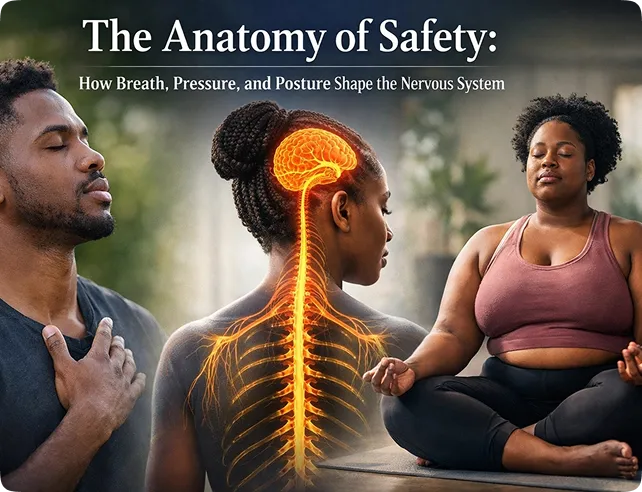
The Anatomy of Safety: How Breath, Pressure, and Posture Shape the Nervous System
Most people believe safety is psychological. I don't. Before the mind labels something as stressful, the body has already made a decision: brace or re spond. That decision is not abstract. It's mechanical.
Safety is created: or disrupted: by how pressure moves through the body, how breath is managed, and how the structure is organized to receive load. Long before thoughts arise, the nervous system reads the body's internal conditions and decides whether it's safe to soften or necessary to protect. This is where most approaches miss the mark.

The problem we're not naming clearly enough
Many high-performing people live in bodies that are constantly preparing for impact.
You see it in patterns like:
Shallow or restricted breathing
A ribcage that barely moves
A pelvis held in a fixed orientation
Feet that don't fully receive weight
Chronic jaw, tongue, or neck tension
These are not bad habits. They are adaptive strategies.
At some point, the nervous system learned: "This configuration keeps me functional." And so it re peats it: even when the cost becomes chronic tension, poor recovery, emotional reactivity, digestive strain, or loss of sensation.
Nothing is "wrong." But the system never got updated.
Posture is an outcome, not a command
Your body organizes itself based on how it manages internal pressure against gravity.
But your body still doesn't feel right. The pain keeps coming back. The tension never fully releases. You feel anxious for reasons you can't quite name. You're exhausted from holding yourself together all day. And somewhere deep down, you wonder: Is this just how my body is now? Is this just aging? Am I doing something wrong? Here's what I've learned after years of working with bodies: You're not broken. You're not weak. You're not doing anything wrong.
You're just missing one fundamental piece of information.
WHAT YOU'LL LEARN
This four-week self-guided course will give you a complete introduction to the BODI KEMiSTRi methodology. It's designed for you to move at your own pace, practice in your own space, and build a foundation that will serve you for life.
Week 1
Understanding Your Pressure System
How your body manages internal pressure.
Diaphragm and pelvic floor connection.
Why pressure improves stability.
Simple breathwork to feel pressure.
Week 2
The Five Anchors
How to engage key body anchors.
Anchoring vs bracing explained.
Signs of effective anchoring.
Foundational anchor exercises
Week 3
Identifying Your Compensation Pattern
The four main compensation patterns.
Identifying your pattern.
Why your pain and tension occur.
Targeted exercises for your pattern.
Week 4
Building Your Daily Practice
Using pressure in daily movement.
Morning and evening anchor routines.
Breathwork for nervous system calm.
Fixing common challenges.
Safety is a pressure-management issue
At the core of Bodi KEMiSTRi™ is a simple, testable observation: The human body is a pressure-regulating system interacting with gravity.
Every breath creates internal pressure. That pressure must be distributed somewhere. When it distrib utes well:
Muscles respond instead of brace
Joints share load instead of compress
Emotions pass instead of lodge
The nervous system downshifts without force
When pressure cannot move, tension becomes structural. Holding becomes identity. Regulation be comes effortful.
This is not a mindset issue. It's a mechanical one.

THIS IS FOR YOU IF...
You have chronic pain or tension that doesn't fully resolve with stretching or strengthening.
You feel anxious or unsettled in your body without knowing why.
You're exhausted by the end of the day from holding yourself up.
You've done yoga or Pilates but never quite felt the stability everyone talks about.
You're pregnant or postpartum and want to prepare your body for birth or recovery.
You sense something is off with your posture or breathing but don't know how to fix it.
You're curious about the connection between your body and your nervous system.
You're ready to invest in learning something that will serve you for the rest of your life.
WHY THIS MATTERS NOW
Most people spend years, sometimes decades, chasing symptoms. A little pain here, some tension there, anxiety that comes and goes. They try everything they can think of, and some things help a little, but nothing really resolves it.
That's because they're treating the symptoms, not the root cause.
The root cause is that your body never learned how to regulate its internal pressure system. And without that foundation, everything else is just a Band-Aid. The earlier you address this, the more time you save. The more pain you avoid. The more life you get to live without your body working against you.
This work isn't complicated, but it is foundational. And once you have it, you have it forever.
YOUR INVESTMENT
This four-week course is $97
That's less than two massage sessions. Less than a month of a gym membership. Less than a co-pay for a few physical therapy visits.
But here's the difference:
Those things are temporary relief. This is permanent understanding.
Once you understand how your body creates stability through pressure, once you know how to regulate your anchors, once you can feel when your nervous system is reading safety versus threat—you don't un-learn that. It becomes part of how you move through the world.
And if you want more support after the four weeks, if you're ready to go deeper and work one-on-one with me, this course is the perfect foundation. Many people move into private sessions with me after completing this program because they've already built the vocabulary and awareness we need to do truly transformative work together.


WHAT MAKES THIS DIFFERENT
I'm not here to sell you another fitness program or another quick fix. I'm here because I've spent years understanding how bodies work, how they lose organization, and how they find it again.
I've worked with women through pregnancy and birth. I've worked with people in chronic pain who've tried everything. I've worked with athletes who were strong but unstable. And what I've learned is this: when you address the pressure system, everything else follows.
This isn't about doing more. It's about doing less, but with precision. It's about learning to feel what your body is doing and giving it what it actually needs.
Most movement teachers focus on what things look like from the outside. I focus on what's happening inside: where the force is going, whether your joints are centered, whether your nervous system feels safe.
That's what makes BODI KEMiSTRi different. And that's what makes it work.
Helpful Information
Clear answers to common questions about the work, sessions, and what to expect.
Do I need any equipment?
No. All exercises can be done with just your body. If you want to add props later (like a small ball or yoga block), that's optional, but not required.
How much time do I need each day?
Plan for 15-30 minutes per day. Some days will be shorter practice sessions, others will be longer learning modules. You can adjust based on your schedule.
What if I'm dealing with chronic pain or injury?
This work is particularly helpful for chronic pain because it addresses the root cause: pressure dysregulation. However, it's not a replacement for medical care. If you have an acute injury or medical condition, please consult your healthcare provider first. This is educational movement training, not medical treatment.
Is this like yoga or Pilates?
There are some similarities, but the focus is different. BODI KEMiSTRi emphasizes internal pressure regulation and joint centration rather than flexibility or strength alone. You'll learn how to organize forces inside your body, not just how to make shapes with your body.
Can I do this if I'm pregnant?
Absolutely. This work is especially valuable during pregnancy because it teaches you how to regulate pressure, which is essential for birth. Many of the principles were developed through observing what makes labor easier and more efficient.
What if I want more support after the four weeks?
Many people move into one-on-one work with me after completing this course. This program gives you the foundational understanding, and then we can go deeper together in private sessions. You'll find information about private work on my website.
How long do I have access?
Lifetime. This is yours to keep and revisit whenever you need it.
What if this doesn't work for me?
This work is based on biomechanics and nervous system science. It works when you apply it. However, if you complete the four weeks and genuinely feel you haven't received value, reach out to me directly. I stand behind this work and I want you to feel good about your investment.
Your body already knows how to do this.
You just need someone to show you the way.
The Pressure Gate System
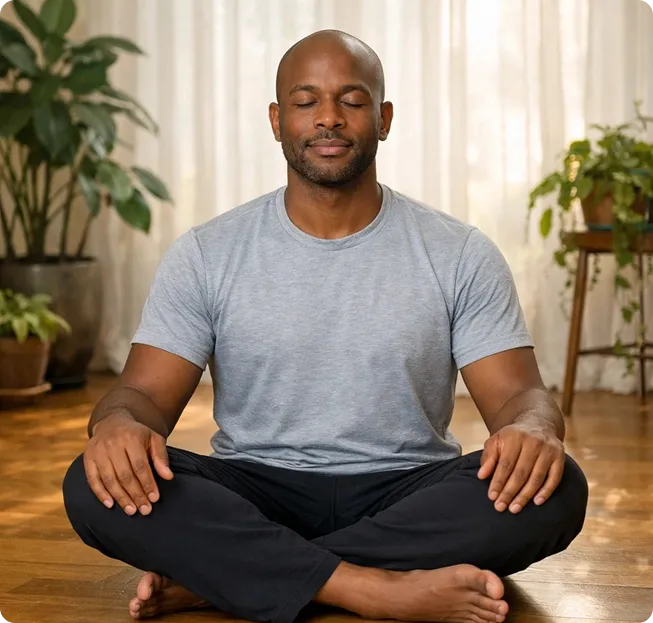
Rather than speaking loosely about "multiple diaphragms," Bodi KEMiSTRi™ uses a clinically cleaner frame: pressure gates. Pressure gates are not single structures. They are functional boundary regions where pressure is con tained, transferred, or released.
The body regulates pressure across five primary gates:
Cranial Gate– head balance, jaw tone, upper cervical orientation
Oral-Nasal Gate– tongue position, airway resistance, breathing rhythm
Thoracic Gate– ribcage and respiratory diaphragm working as a pressure chamber
Pelvic Gate– load distribution through the pelvis into the legs
Podal Gate– interaction with ground reaction force through the feet
When one gate restricts, others compensate. When compensation becomes chronic, safety is re placed by control.
Why anchors matter
Most people cannot directly feel pressure gates. So we use anchors: clear, tangible reference points the nervous system can trust:
Tongue placement
Ribcage and shoulder orientation
Pelvic organization
Foot contact with the ground
Anchors are not posture cues. They are access points. They give the system enough stability to reor ganize pressure without forcing relaxation. When anchors are present, breath changes on its own.
What changes when safety becomes embodied
People often expect dramatic emotional releases. What usually happens instead is quieter: and more profound:
Breathing becomes less effortful
Joints feel less compressed
The body needs less "holding" to function
Emotional boundaries become clearer
Recovery improves
Not because they tried harder. Because the body stopped overworking.

What safety actually is
The goal is not perfect posture. The goal is not a calm personality. The goal is structural permission for the nervous system to respond appropriately to life. That's what safety actually is. And it's mechanical first.
If these ideas resonate, the next step isn't trying to apply them intellectually. It's seeing how your body is currently organizing pressure: and what strategies it's using to feel safe. That's what the Bodi KEMiSTRi™ assessment is designed to reveal. Awareness creates choice. Choice creates change
